OUR CULTURE
GAGALO: A Living Heritage of Iwoye-Ketu by Abel Babatunde
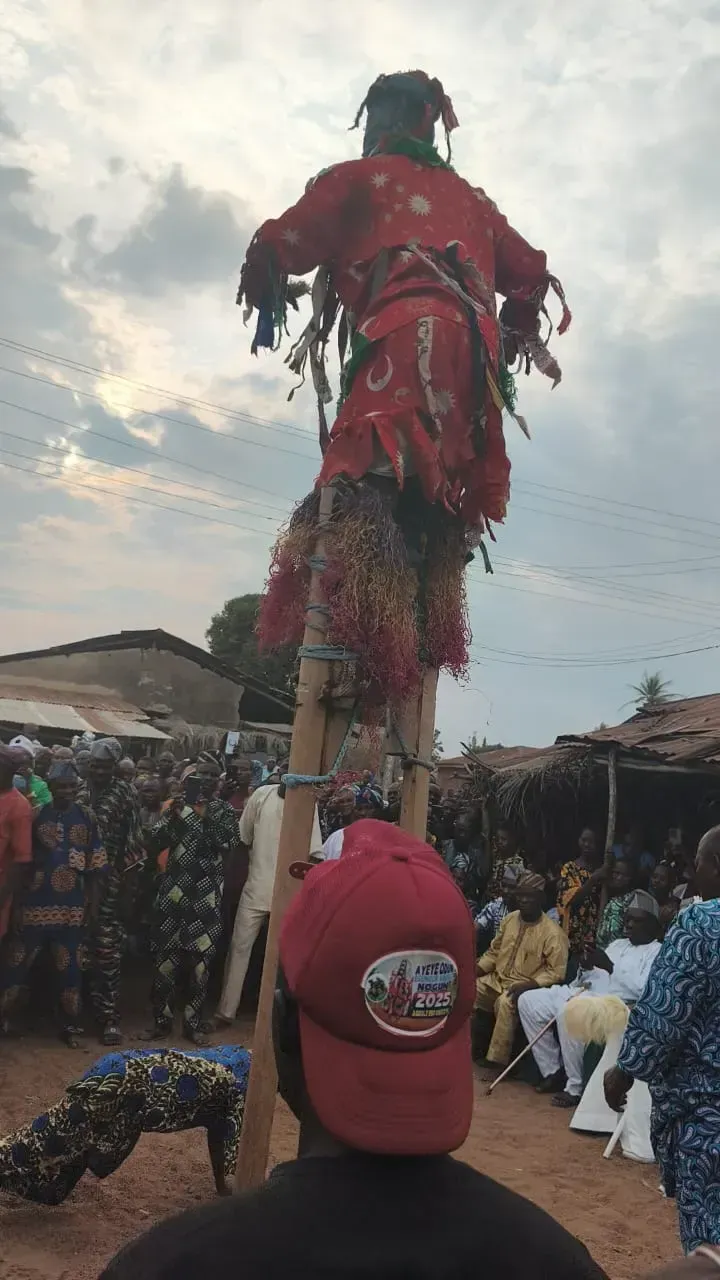
Gagalo is a vibrant performance art rooted in the rich cultural traditions of the Yoruba people. It is one of the unique communal expressions that shaped my childhood in Iwoye-Ketu, a historic town at the origin of the Yewa River, from which the entire Yewa region of Ogun West Senatorial District derives its name. Iwoye-Ketu, straddling both Nigeria and the Benin Republic, is not only a binational community but also a foremost Yoruba kingdom that proudly produced the first three Aare Onakakanfo of Yorubaland.
I was recently privileged to witness Gagalo once again during the coronation of His Royal Majesty, Oba (Sir) Isaac Adegbenro Oyero (Adekiluroju — Ada Paako II), the Ooye of Iwoye-Ketu Kingdom, on 6th August 2025. The performance, held at the bustling central market square, reminded me of the vibrancy, humour, and communal spirit that make this art form so distinct.
The Art of Gagalo
A Gagalo performer mounts a specially crafted bamboo apparatus, with both legs tied to the poles, and appears in brightly coloured attire with a partially concealed face. The length of the bamboo varies — long, short, or medium — depending on the age, skill, and confidence of the performer. What unfolds is a dazzling display of balance, rhythm, and improvisation.
Gagalo is performed purely for entertainment, and it is offered freely to the public. Yet, the audience is not passive: their role is to sing, clap, and dance, providing the rhythm that fuels the Gagalo’s daring tricks. The songs, distinct to Gagalo performances, are often witty, humorous, and sometimes teasing, designed to provoke the performer into playful chases and acrobatics without losing balance.
One such song in the Ketu dialect playfully goes:
Epun e han nne o
Eeeeee o, epun e han nne o
B’odele I bo sookoto
Epun e han nne o
Translated:
Your scrotum is exposed,
Indeed, it is exposed,
When you get home, wear your trousers,
For your scrotum is exposed.
At this chorus, the Gagalo typically charges toward the spectators — often the women — to the delight and laughter of the crowd.
Custodians of the Tradition
The young men of the Eekanjare compound in Iwoye-Ketu are particularly renowned for their natural gift in Gagalo performance, although the art is open to anyone willing to learn. I recall personally attempting it in those days, only to realize that not everyone is destined to master the skill — it takes exceptional strength, reflex, and rhythm.
Over the years, Gagalo has become an essential part of community entertainment, delighting visitors, dignitaries, and locals alike. Traditionally, Sundays were regarded as Gagalo days in Iwoye-Ketu. On such occasions, churchgoers often grew restless if services extended too long, eager to witness the thrilling performance at the central square. In fact, pastors would sometimes resort to dramatic preaching to keep their congregations seated until dismissal. By evening, however, all activities paused as the entire community gathered to enjoy the spectacle.
A Living Cultural Treasure
Beyond its humour and spectacle, Gagalo reflects the essence of Yoruba communal life — creativity, resilience, and shared joy. It is a performing art that unites generations, engages the community in active participation, and reaffirms cultural identity.
As global conversations on intangible cultural heritage grow louder, traditions like Gagalo deserve recognition and preservation. They are not only sources of entertainment but also living archives of collective memory, humour, and artistry. For Iwoye-Ketu, Gagalo is more than performance — it is heritage, identity, and a joyful expression of Yoruba resilience to the world.
Abel Babatunde writes from Iwoye-Ketu, Zone4, Imeko/Afon LG., Ogun State. He can be reached via [email protected]
The Mystery and Magic of Oròkórò Festival in Iwoye-Ketu

When October draws near in Iwoye-Ketu, a quiet buzz begins to sweep through the community. People know what’s coming. It is the season when voices from a mysterious world, Jàkinijá, come visiting. It is the time of the “Oròkórò Festival” — a tradition that makes this town in Ogun State stand out among Yoruba communities.
For centuries, the Yoruba have celebrated Orò, a sacred festival reserved for men. Women are forbidden from seeing it, and visitors must tread carefully during its season. Orò can be called out to mark the death of a king or chief, to drive away evil, or to restore balance when calamities strike. But in Iwoye-Ketu, Orò has a special twist. Here, the festival is not just Orò, it is “Oròkórò”— and that makes all the difference.
Elders say Oròkórò comes from “Jàkinijá”, a place no one can describe. No one knows how to get there, yet every year its residents arrive. Unlike the regular Orò, this one speaks with a strange human-like voice. The tone is unusual, almost otherworldly, but beautiful enough to draw admiration even from women who are not allowed to see them.
Beyond Iwoye-Ketu, only the neighbouring town of Ijio in Oyo State is said to have something similar. That rarity makes Oròkórò even more special.
The festival usually begins in October, sometimes stretching into November. On the eve of the event, the “Olórò”— members of the Orò cult — take to the streets at dusk, singing and drumming to announce what is about to unfold.
One of their most popular chants goes like this:
Yoruba (original):
Odede o gb’oro
Odede o gb’oro
Laaabe odan ni ta n ke
Chorus:
N o mu, n o mu, ita n ke
N o p'aja fun baba, ita n ke
English Translation:
Orò is not an indoor thing
Orò is not an indoor thing
Its arena is under the tree outside
The Mystery and Magic of Oròkórò Festival in Iwoye-Ketu

Iwoye-ketu is a border community in Ogun State. As a custom, it is a taboo for residents to use umbrella or rear pigs. GBENRO ADEOYE, who visited the community, reports on the agelong tradition
It’s the start of another rainy season, a time when people sometimes walk in hurried steps with umbrellas in hand to ward off the rain.
But in Iwoye-ketu, a border community in Imeko/Afon Local Government Area of Ogun State, residents would rather get wet than do that. The use of umbrella is a taboo in the community.
The custom dates back hundreds of years, estimated to go as far back as 1705 when its first settlers discovered the land. Since then, the legend has been passed down from generation to generation. Although, its essence has been lost on some of the community’s younger generation, they dare not break the tradition up till the present day.
Split between Nigeria and Benin Republic, Iwoye-ketu is about 98km away from Abeokuta, Ogun State capital and bordered by Iwajowa Local Government Area in Oyo State to the north and the Francophone country to the west.
One of the closest towns to the community is Imeko Afon, about 17km away. A bumpy motorcycle ride, which is the popular means of transportation on the dusty Imeko-Iwoye Road, takes about 30 minutes to get to Iwoye-ketu.
With an official figure from the 2006 census putting the population of Iwoye-ketu at 25,000, the present population of the community is estimated to have grown to between 50,000 and 75,000.
‘No use of umbrella here’
Legend has it that one of the first settlers of the community, Olumu, who was said to have been a powerful man from Ile-Ife in Osun State brought three items along with him to Iwoye-ketu: a crown; a staff called Opa Ogbo; and his deity called Orisa Oluwa.
The shorter version of the legend is that it is Orisa Oluwa that forbids the use of umbrella in Iwoye-ketu and Wasinmi, a relatively smaller community under its control up till the present day.
In addition, the deity is also said to forbid the rearing of pigs in the communities.
Our correspondent did not sight a pig or anyone using an umbrella during his visit to the community.
But interestingly, there are no known consequences for people who defy the custom. However, that has not affected the strong level of compliance with the rules by the residents.
“It’s the Orisa that doesn’t want umbrella to be used here. It also detests pigs because they are dirty. We have abided by the rules because we (residents) know the custom. Children are told about the custom and when strangers come in, we also let them know they cannot use umbrella or rear pigs here,” said the Ooye of Iwoye-ketu (community’s king), Joel Aremu.
He described the use of umbrella within the community as an affront to the deity as he told the story of how the community’s legendary early settler divided the Ogun River with his staff, similar to the Bible’s account of how Moses parted the Red Sea to rescue thousands of Jews from slavery and oppression in Egypt, famously known today as The Exodus.
“Our residents can use umbrella outside the community; it’s in the community that it’s forbidden. We inherited the tradition from our forefathers and we have guided it since then because we respect our culture. Thankfully, no one defies the rule,” the Ooye of Iwoye-ketu said.
“When strangers come into the community and use their umbrellas, we don’t harass them, we only tell them it’s against our tradition and they always abide by it. Nothing bad will happen if someone uses the umbrella but it’s our tradition and we want to keep it that way.”
Saturday PUNCH observed that many residents of the community, including Aremu, own umbrellas which they use outside the community.
“I have an umbrella in my car and I use it outside the community,” Aremu confirmed to our correspondent.
However, there is a longer version of the story as told by elders of the community.
One of them, Mr. Jonathan Idowu, 75, said the story began with the earliest hunters of the community. Idowu’s late father was one of the community’s most celebrated hunters.
He said, “In those days, our forefathers used to hunt elephants in the forests. Since elephants have big ears that are wide like an umbrella, they felt threatened by the sight of umbrellas anytime they saw hunters with them.
“Most times, the elephants would chase after them. In spite of their size, elephants are fast animals. When an elephant is running, you will only see the dust rising after it because it’s so fast.
“As a result, there were many vicious attacks by elephants on the hunters. And since it was the tradition of hunters to consult with Orisa Oluwa before setting out, later, the deity warned them against the use of umbrellas.
“We (residents) obeyed whatever Orisa Oluwa told us to do. If it told the hunters not to go out and that they would be killed in the forest if they did, they would stay at home. Orisa Oluwa was also consulted in the wartime. So when it forbade the use of umbrellas, we obeyed and have obeyed since then.”
Idowu also told of how attires like gowns worn by masquerades equally elicited violent reactions from elephants back in the day.
“An elephant, with its size, appears like an object wearing a cloak so it could also be threatened by anyone who appeared like a masquerade,” he said.
Meanwhile in the absence of umbrellas, residents are accustomed to the use of polythene, clothes, hoods, rain coats, boots and traditional woven hats (akete), depending on their suitability to the sun or rain.
For instance, a 40-year-old trader in the community, Mrs. Modinat Adepoju, said she has grown to rely on other things in place of an umbrella.
Adepoju, whose last child is still a toddler, said anytime it rained or the sun became too hot while she was out with her baby on her back, she would spread a piece of cloth or polythene over her as protection against the harsh weather element.
“The taboo is not strange to us since we grew up with it. Sometimes I wear akete and give to my child that is older to wear too. And when I go outside the community, I use umbrella. I have one at home,” she told our correspondent.
A community split between two countries
Iwoye-ketu is a multi-cultural community with its over eight ethnic groups which include Yoruba, Hausa, Fulani, Igbo, Egun, Ohoi and Igede.
A concrete pillar within the community separates the section under the Nigerian territory from the part that falls under Benin Republic, although residents see themselves as one since both fall under the authority of the same monarch- Ooye of Iwoye-ketu.
Saturday PUNCH learnt that the boundary dividing the community along international lines had been demarcated since the colonial era but with little regard for its sanctity in the early post colonial period. Following the indiscriminate construction that sprang up all around the border line, a former Minister of Works and Housing, the late Gen. Abdulkareem Adisa (retd.) under the military regime of General Sani Abacha, redefined the border and demolished some illegal structures in the community.
But at the Benin Republic end of the community, also called ‘French’ by residents, the taboo is also strongly respected.
A gendarme at a police post belonging to Benin Republic, Tonasse Germain, who spoke to our correspondent through a translator, confirmed that the French speaking section of the community also complies with the age long tradition.
He said residents have learnt to read weather signs and work with them.
“We don’t have any problem with the tradition since Iwoye is one and we’re under one king. We watch the weather, when it looks like it would rain, I will stay indoors if I don’t want to get wet. And if it’s important, I can hold a polythene over my head. Some people wear raincoats and the like,” he said.
Iwoye-ketu is also one of four locations in Ogun State where agricultural students of the Federal University of Agriculture, Abeokuta go annually for their Farm Practical Year, the equivalent of industrial training undertaken by students offering non-agriculture related courses.
New students are posted to the school’s Iwoye-ketu farm every session, where they are required to stay for a minimum of seven months. Our correspondent learnt that 350 students from the school were currently undergoing the training in the school farm located in Iwoye-ketu.
Some of them could not understand the reason behind the taboo and why they should be affected. They described the taboo as strange and wondered how the residents of the community had managed to cope with it for a long time.
“I feel sorry for them still. The people of the community are still tied to an old tradition that has nothing to do with this age. I think they are only punishing themselves but who are we to complain since we’re only here for a while?” One of them who did not want his name published told our correspondent.
There are also pockets of youths in the community who suffer in silence but have been afraid to speak against the tradition for fear of castigation by the elders.
Some of them argued that Orisa Oluwa has lost its relevance in a modern age that has opened their eyes to other religions like Christianity and Islam.
“Nobody goes there to worship again like before,” a teenager who identified himself as Dayo said.
Findings by Saturday PUNCH indeed showed that only some elders of the community still visit the shrine of Orisa Oluwa to perform the required annual rites done in August or November of every year.
The rites involve pouring water fetched with only gourds and calabashes on the deity. No plastic buckets or alcoholic drinks are allowed near it and only some specific persons are allowed to move closer than 10 metres to the shrine.
Therefore, most residents of the community don’t know what the deity looks like. In the absence of Mr. Ogundele, who tends to the shrine, our correspondent learnt from someone in his household that the deity lives in a calabash.
Our correspondent’s visit to the shrine showed a pavement amidst a bushy area.
The residents described it as the start of an ongoing renovation exercise at the shrine.
Reacting to the critics of the deity, Idowu criticised them for questioning its potency, describing Orisa Oluwa as deserving of reverence by the young and the old. He recalled that in his younger days, no one dared cast aspersions on Orisa Oluwa’s potency.
“When we were young, if it did not rain in the community for long, the community would fetch water and pour on Orisa Oluwa. A heavy rain would fall within an hour of performing the rite,” he recalled.
“Some of us who did not leave the shrine immediately would be drenched in the rain on our way home. That was the power of Orisa Oluwa.”
Party politics
Incidentally, umbrella is the logo of the Peoples Democratic Party, the ruling party in Nigeria. And trust politicians from the opposition parties, they would not miss an opportunity to use the taboo to their benefit during political campaigns.
Apart from the fact that PDP members cannot put up umbrellas during campaigns in the community, members of the other parties also make it a point of duty to remind residents that the deity of the land forbade the use of umbrellas.
“We tell people not to accept the party with the umbrella logo because our deity forbids the use of umbrellas. Of course, they are political statements and some residents know that but we might be able to win a few sentimental people to our side through that,” the youth leader of the All Progressives Congress in Iwoye-Jabata ward, Mr. Idowu Odekunle, told our correspondent.
Mr. Peter Bamgbowu, PDP Secretary, Iwoye-Jabata ward, who confirmed the situation said as a result, his party members sometimes have to explain to residents that his party was not after destroying the tradition of the community.
“During campaigns, some people will say ‘go away, we don’t use umbrella here.’ We explain to them that it’s only a logo and that it doesn’t mean we want to use umbrellas in the community,” he said.'
Taboo on pig rearing
Known as a nomadic tribe, a large Fulani population in Iwoye-ketu makes the community a destination for lovers of beef. Even though, pork is eaten by some of the residents of the community, it is a taboo to rear them.
Legend has it that a bad omen awaits any pig that strays near Orisa Oluwa shrine.
“Because Orisa Oluwa does not like pigs, any pig that goes too close to its shrine will die mysteriously. So it became a taboo for anyone to rear pigs in the community,” Idowu said.
However, findings showed that some residents living on the outskirts of the community rear pigs.
Let Us Come Together and make Iwoye-Ketu Great
08032834000
+234 803 437 0758
Contact Address: Ooye of Iwoye-Ketu Palace, Iwoye-Ketu, Imeko-Afon LG., Ogun State, Nigeria.
SUBSCRIBE TO OUR NEWSLETTER